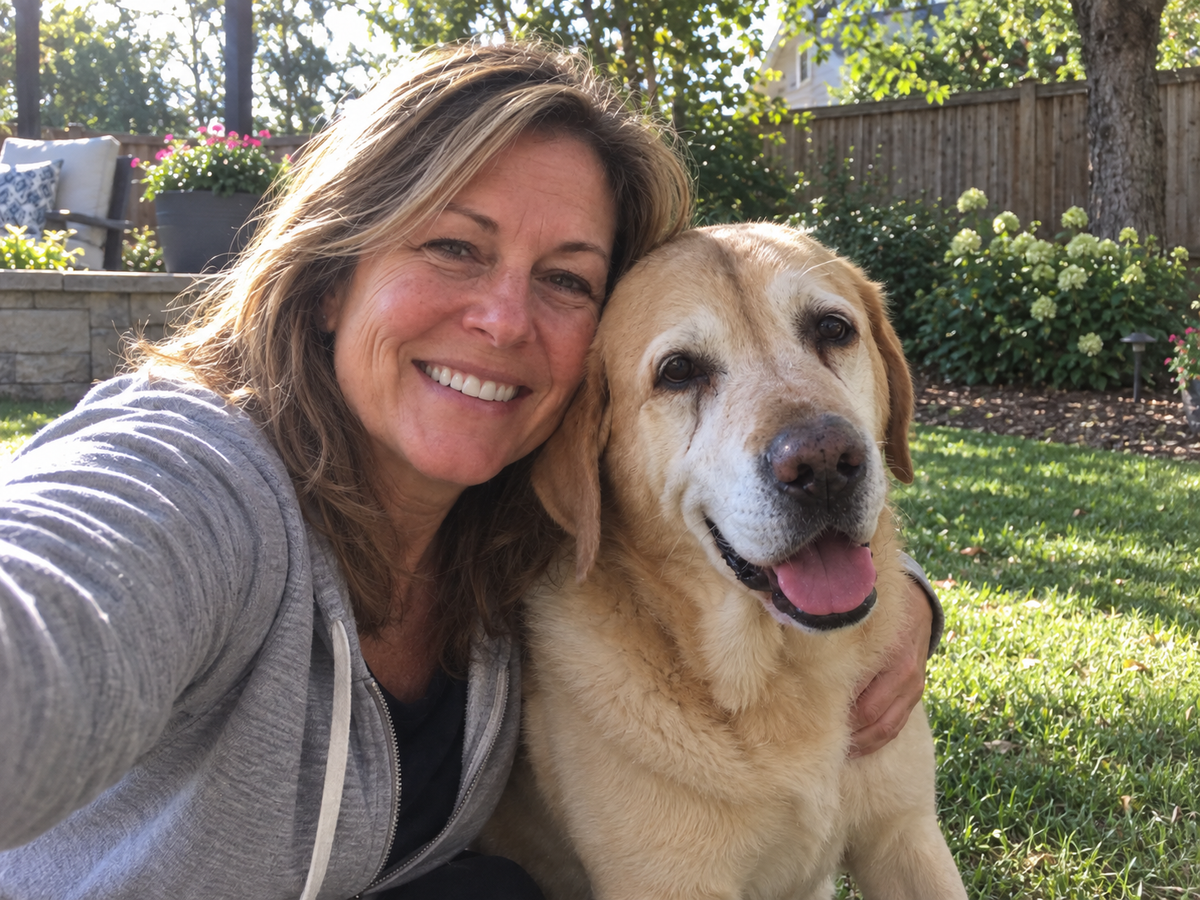
The first time Cooper couldn't get up, I was standing three feet away with a coffee in my hand.
He'd been asleep on the kitchen floor like always. He heard the treat jar, pushed up with his front legs, and his back end just stayed down. His nails scraped the hardwood, he slid to one side, and he looked at me.
Not scared. Confused. Like he was waiting for me to explain it.
I put the coffee down, got behind him, wrapped my arms around his belly, and pulled. He grunted. I let go. I tried again, lower this time, and felt his ribs shift under my hands, and I stopped, because I was sure I was about to hurt him.
We stayed there on the floor for a minute, both of us breathing hard, until he got up on his own.
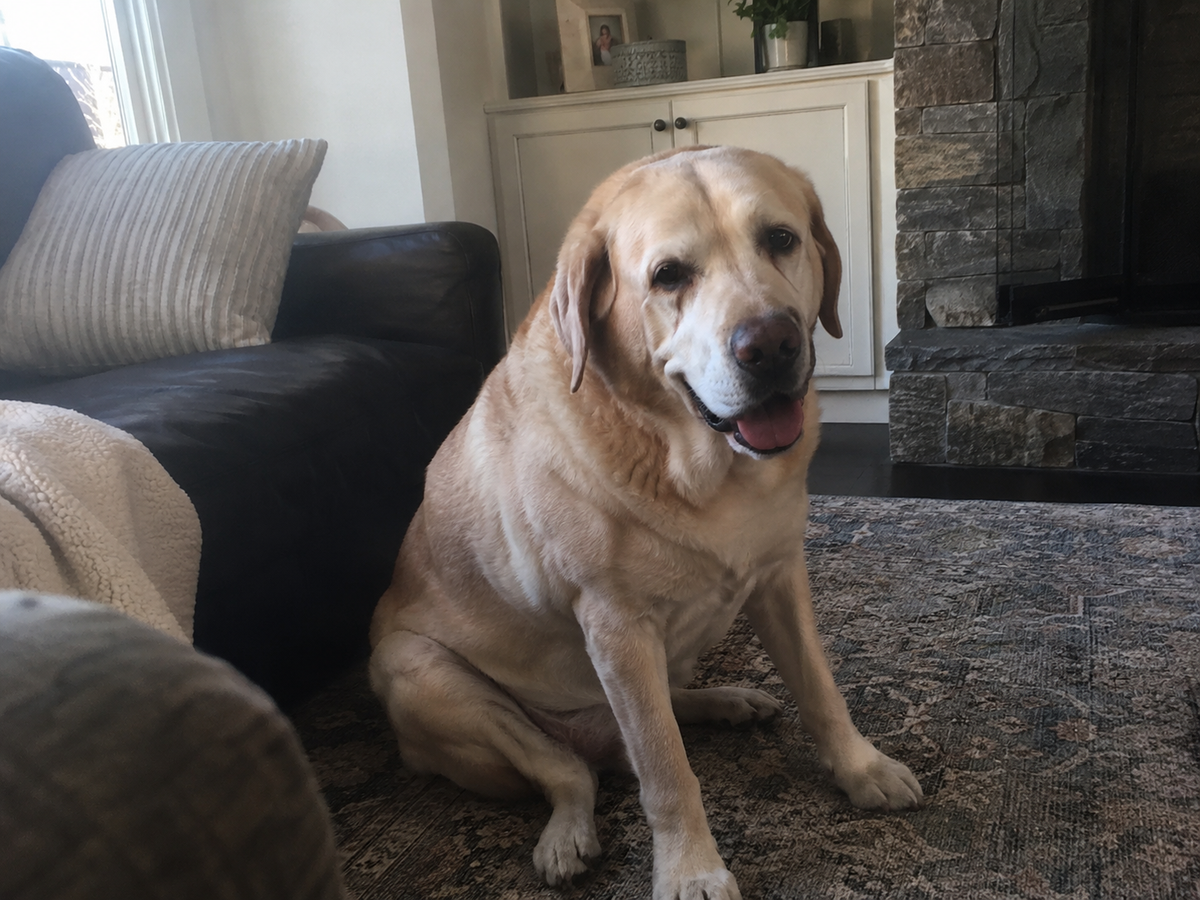
Cooper is a 12-year-old yellow Lab. Eighty-five pounds. He's slept on the same spot in the kitchen since he was a puppy.
After that morning it happened again a few days later. Then every couple of days. Then every morning, and again after his afternoon nap, and again when he tried to get up off the porch.
If you've been here, you know the feeling. It isn't one big moment. It's a dozen small ones every day. He tries, he fails, he looks at you. And you're the one who's supposed to fix it.
The thing nobody warns you about is how much of it is about your hands. Where do you grab an 85-pound dog whose back half has quit? Under the belly, you're squeezing his stomach. Around the chest, you're dragging him up by the front while his back legs hang there. By the hips, he flinches.
My husband works nights. Most of the time it was just me and Cooper and the floor.
I did what everyone does first. I bought rugs. Runners in the hallway, yoga mats by his bed, those puzzle-piece foam squares from the kids' section in front of his water bowl. It helped once he was standing. His paws stopped skating out. But rugs don't lift a dog. They just changed where he got stuck.
Then a friend told me about the towel trick. Fold a bath towel long, slide it under his belly, hold both ends, lift.
It worked, sort of, for about a week. Then I learned what everyone with a towel learns.
Why the towel kept failing us
It bunches. The second he shifts his weight, it rolls into a rope and rides back into his groin. Both hands are occupied, and all his weight hangs from a narrow strip pressing into his belly.
One night on the back steps he lurched forward, the towel slid, and I went down on my knee to keep him from going face-first into the yard. I sat on the step afterward and cried, mostly because I'd almost dropped him, and partly because my back had been hurting for three weeks and I hadn't told anyone.
I looked at the harnesses at the pet store. Big padded vests with straps everywhere. Cooper hates having anything on him, and I couldn't picture wrestling him into one while he was flat on the floor.
I looked at ramps. At slings online with one-star reviews that said "slid right off his hips." At a $400 wheelchair that felt like giving up.
Mostly I kept using my hands, and hoping.
The thing that changed it was a vet tech named Dana.
Cooper was in for bloodwork. When it was time to stand him up off the exam room floor, I got down to do my usual belly-grab, and she stopped me.
“Can I show you something?”
She slid a padded strap under him, just in front of his back legs, took the handle in one hand, and lifted his back end about four inches. Cooper pushed up with his front legs and was standing in two seconds. No grunt. No flinch.
Then she explained what I'd been doing wrong for four months, and it wasn't what I thought.
“His front end still works,” she said. “The problem is he can't get his weight back over his hind legs to push. So he pushes with his front, his back end stays down, and he slides. When you grab his belly and pull, you're lifting the wrong part in the wrong direction.”
That was the flinch. Not the lift itself. Where I was lifting.
What she'd used is called a rear support harness. Rehab clinics have used some version of it for decades, going back to a rolled towel under the hips.
He does the front.
You do the back.
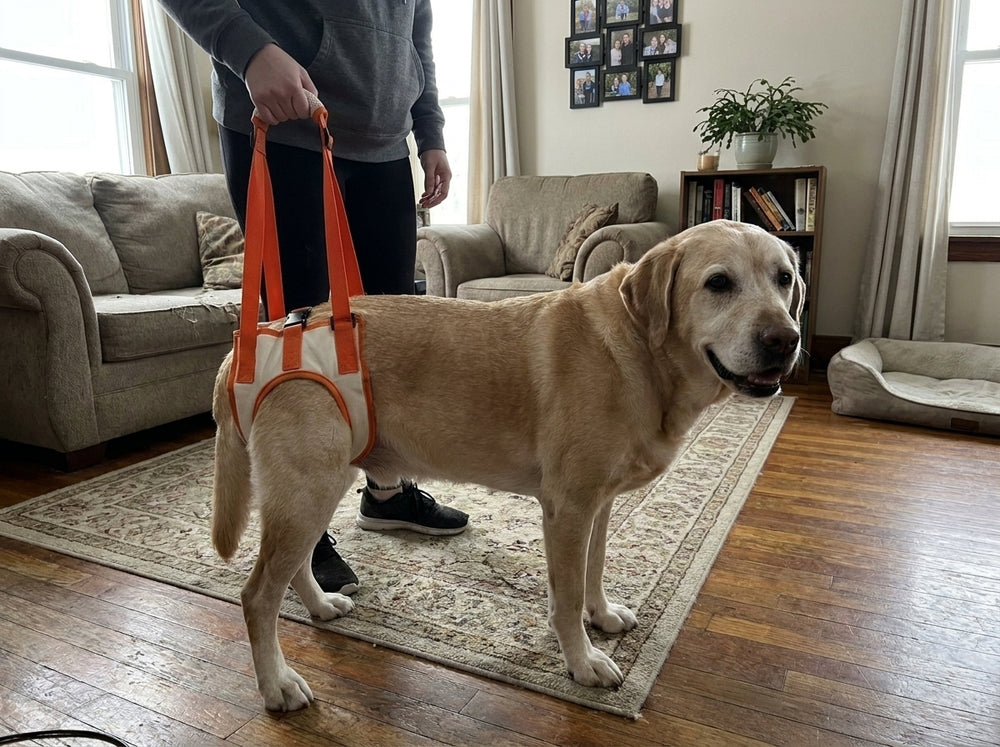
His working front legs do what they still can.
A wide padded panel gently raises the rear.
His balance moves forward instead of hanging from his belly.
Instead of a strip under the belly, a wide padded panel sits under his hips and the tops of his back legs, where the bone is. A handle comes up over his back. You lift the handle, his back end rises, and his weight shifts forward over his front legs so he can do what he still can.
Because the pressure is on his hips instead of his belly, he doesn't flinch. Because it's one handle, your other hand is free for his collar, the door, the railing. Because it's padded and shaped, it doesn't roll into a rope or ride into his groin.
And Dana said something I've thought about every day since: “You want to help him stand, not carry him.”
Two Saturdays later I was at the park, and I saw a woman with a gray-muzzled German Shepherd at the back of her SUV.
The dog put his front paws up on the bumper. She took hold of an orange handle over his hips, lifted, and he was in. It took about as long as it takes to read this sentence.
I walked over and asked her about it before I could feel awkward. Her name was Karen, her dog was Bruno, thirteen, hips going. She'd been using a towel for months too. She said the harness was from a company called Dog First Co., that she'd measured him in about twenty seconds with their size guide, and that it came with a 90-day trial, which was the only reason she'd risked ordering another harness after two that didn't fit.
“He barely noticed it was on,” she said. “That's the part I didn't believe.”
I ordered one from my phone in the parking lot. Large, based on Cooper's waist measurement.
20-second size guide · 90-day risk-free trial
I'll be honest about what I was worried about, because I think you're worried about the same things. That it wouldn't hold 85 pounds. That he'd hate it. That he wouldn't be able to pee in it. That it would end up being one more thing in the closet.
The first morning, Cooper was on the kitchen floor in his spot. I knelt down, slid the padded panel under his hips while he was still lying there, which took maybe ten seconds and no wrestling, and clipped it. He sniffed at the strap and then ignored it.
Then I stood, took the handle, and lifted. Not hard. Maybe a third of his weight.
He pushed up with his front and was standing. He shook off like he'd just come out of the lake and walked to his water bowl.
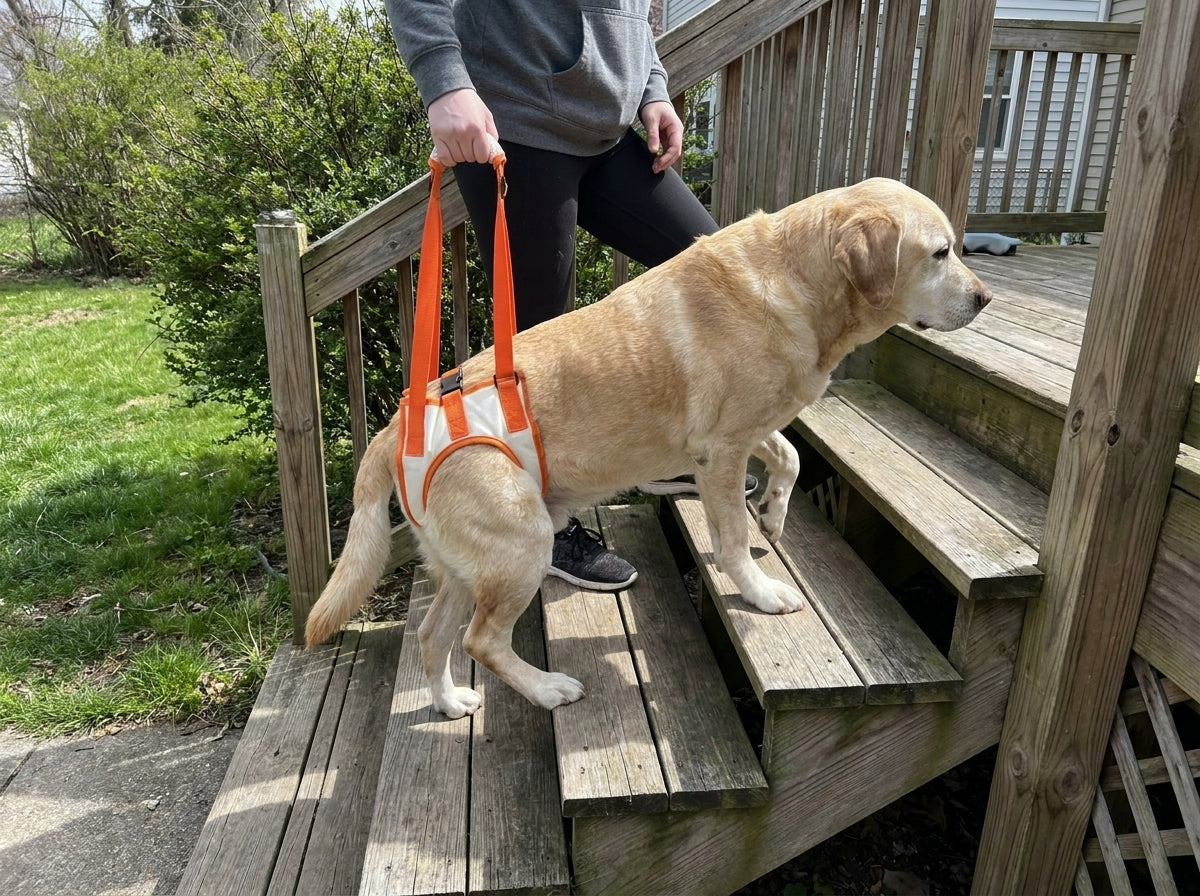
Here's what I learned over the first two weeks:
It holds him comfortably. The panel spreads his weight across his hips, so it never feels like I'm pinching him.
He can go to the bathroom in it. It sits behind everything that needs to stay clear.
It's easy enough for everyday use. He lies down in it, gets up in it, naps in it. I just reach for the handle.
The steps stopped being scary. One hand on the handle, one on the railing, while I keep his back end steady.
My back stopped hurting. I stopped trying to lift all of him.
Free shipping · 90-day risk-free trial
Cooper is still twelve. His back legs are still weak. The harness didn't change that, and I'd be lying if I said it did.
What changed is everything around it.
He goes for his walk again. A short one, around the block, with me holding the handle over the uneven spots. He gets in the car when I pick up my keys, front paws on the seat, me on the handle, and he comes to the hardware store and the drive-through like he used to. Last Sunday he lay in the sun on the porch for two hours and got up on his own twice, and I let him, because now I know I can help if he can't.
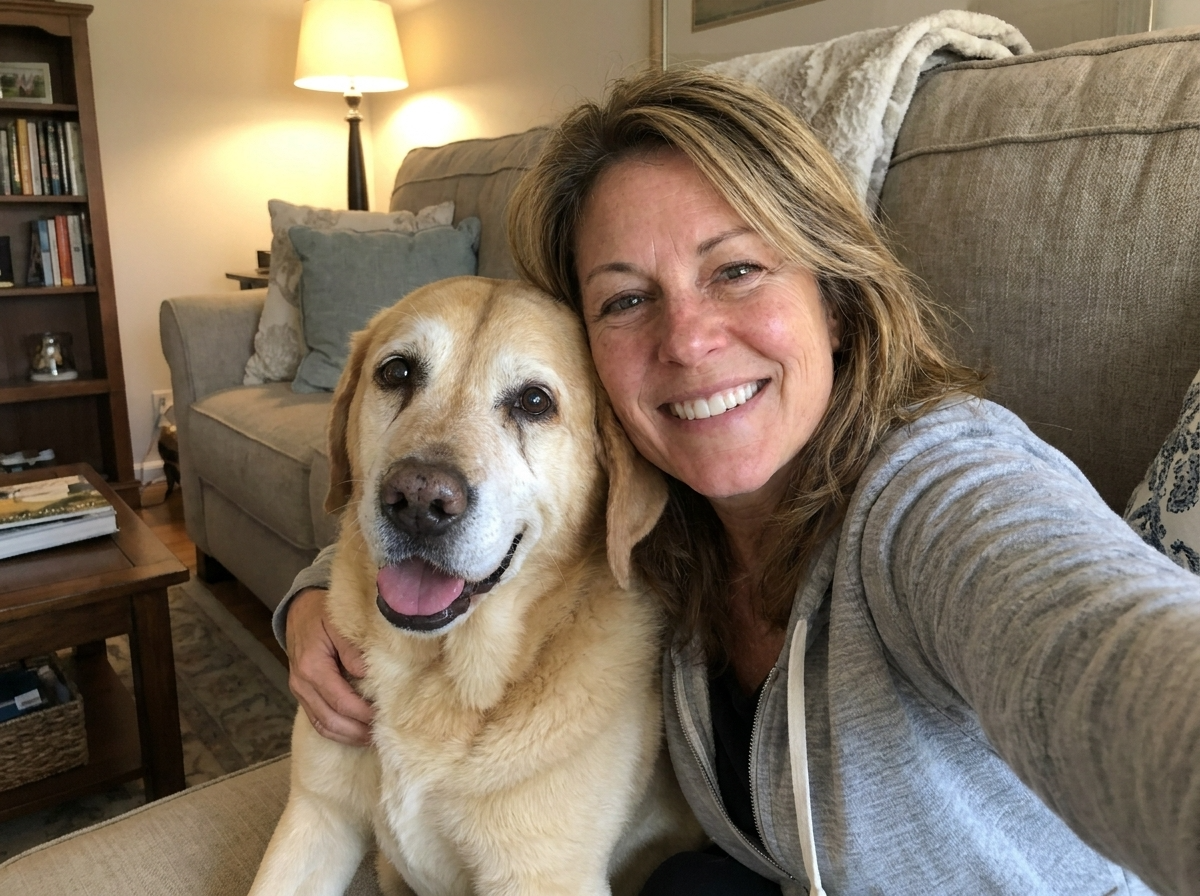
The thing I didn't expect is what it did to me. For four months, every time he moved, I braced. I'd stopped sleeping right. I'd started leaving him home. I'd started doing the math on how much time we had, and I'd started to feel like I was failing him in advance.
That's gone. Not because anything about his body is fixed, but because I finally know where to put my hands.
My husband said it best, watching me get Cooper up off the porch one-handed while I held the door with the other: “You look like you know what you're doing now.”
I do. That was the whole problem. I didn't, and nobody had shown me.
If your dog's back legs have stopped cooperating, and you're reaching under his stomach and hoping, you just need something safe to hold on to.
